
Holiday Home PMS: What It Does & Who Needs One
Property management systems run the booking calendars, guest messaging and daily operations behind most short-term rentals — but the platforms built for agencies managing hundreds of units aren't always the right fit for an owner running one or two. Here's what a PMS actually does, and how to decide what level of system you need.
Holiday Home PMS Explained: What Agencies Need and What Self-Managing Owners Actually Need
Search for "property management software" for a holiday home and you'll quickly land on platforms built to run portfolios of dozens or hundreds of units, priced and designed accordingly. If you own one apartment or villa that you rent out through Airbnb, Booking.com or another platform, much of that software may be overbuilt for your situation.
But the underlying job — keeping bookings organised, knowing when the property is occupied, avoiding conflicting reservations, managing guests, and staying on top of operations — is real work regardless of portfolio size.
Understanding what a Property Management System actually does helps you figure out how much of one you really need.
What does a property management system do for a holiday home?
A Property Management System (PMS) for holiday homes centralises the operational side of running short-term rentals.
Depending on the platform, that can include reservations, guest information, availability, automated communication, cleaning schedules, maintenance tasks, pricing, financial reporting and connections to booking platforms.
For an agency running properties on behalf of multiple owners, a PMS can become the operational backbone of the business. It gives staff one place to manage reservations across the portfolio, coordinate cleaning and maintenance, communicate with guests, and produce reporting or statements for property owners.
For a self-managing owner, the problem is smaller — but many of the same fundamentals still apply.
The operational layer of Property Management Software
Booking and guest management. Every reservation — dates, guest details, booking source, status and other relevant information — can live in one place instead of being scattered across different platform inboxes.
Calendar and availability management. Reservations and blocked dates need to be visible across every channel where the property is offered. This is especially important when the same property is listed on more than one booking platform.
Automated guest communication. More advanced PMS platforms can send check-in instructions, house rules, access details and check-out reminders automatically rather than requiring someone to message each guest manually.
Turnover and maintenance coordination. Cleaning, linen changes and property checks need to happen between one guest leaving and the next arriving. Agency-focused systems may automatically assign those tasks to staff or contractors.
Pricing and availability control. PMS and revenue-management tools can help control minimum stays, owner blocks, seasonal pricing and other availability rules.
Reporting. Operators may track occupancy, booking revenue and other performance metrics. Agencies managing properties for other owners may also need owner statements and payout reporting.
Booking calendars: a simple feature with a big operational impact
One of the most useful features in any holiday home management system is the booking calendar.
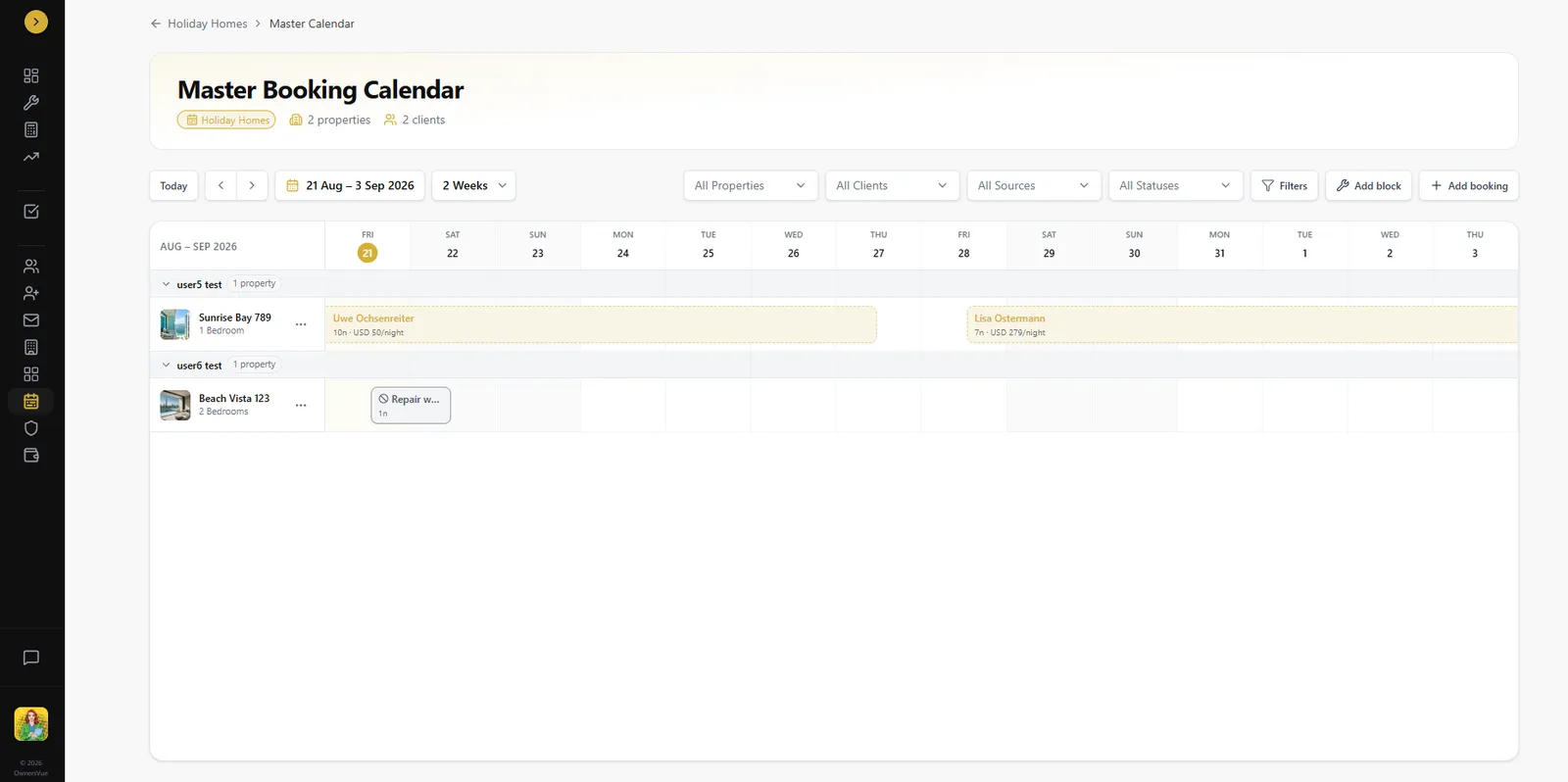
The OwnersVue holiday home management calendar, showing how reservations, blocked dates and property availability can be viewed across multiple holiday homes in one place.
For a self-managing owner, the value is simple: you can see when the property is occupied, when the next guest arrives, which dates are blocked for personal use, and whether there is enough time between bookings for cleaning or maintenance.
Once more properties are involved, the same calendar becomes an operational overview. A property manager may need to see reservations across several units at once, understand which properties belong to which owners, filter bookings by source or status, and identify available periods without opening each booking platform separately.
Blocked periods are just as important as confirmed reservations. A property may be unavailable because of maintenance, repairs, owner use, renovation work or another operational reason. Keeping those periods in the same calendar prevents them from being mistaken for available inventory.
For properties listed on several booking platforms, calendar synchronisation also becomes important. A booking made on one platform should block the corresponding dates elsewhere to reduce the risk of double bookings.
How quickly that information synchronises depends on the technology being used. Direct channel integrations can exchange reservation and availability data quickly, while simpler iCal calendar feeds typically refresh periodically rather than instantly.
For an owner with one or a small number of properties, that simpler approach may be entirely sufficient. For an agency processing a high volume of reservations across many properties and channels, more advanced channel integrations usually become much more important.
The underlying need, however, is the same at every scale: one clear view of when each property is occupied, available or intentionally unavailable.
Do you need a full PMS if you only have one or two units?
Not necessarily.
A full agency-grade PMS is designed around the problems that appear when multiple people are operating multiple properties for multiple owners. Staff task assignment, multi-owner accounting, automated workflows, advanced channel integrations and portfolio-wide pricing rules all make sense when those operations happen every day.
For an individual managing one or a few properties, those same features can create more complexity than they remove.
The line isn't really about property count on its own; it's about who's doing the work.
A property manager or agency acting on behalf of multiple owners needs tools for coordinating clients, properties, staff and bookings simultaneously.
An owner managing their own holiday home doesn't need to generate an owner statement for themselves or create complex staff permissions. They may simply need a reliable booking overview, calendar synchronisation, guest records, blocked dates and visibility into what needs attention next.
Agency PMS vs. owner-level tools: where the line actually falls
| Agency-grade PMS | Lightweight owner tools | |
|---|---|---|
| Built for | Managers operating properties for multiple owners | Owners managing their own small portfolio |
| Booking calendar | Portfolio-wide across properties and clients | Clear overview of the owner's own properties |
| Channel management | Direct integrations and advanced distribution | Calendar sync may be sufficient |
| Staff operations | Cleaning teams, task assignment and permissions | Usually unnecessary or much simpler |
| Owner reporting | Statements, payouts and owner accounting | Owner already sees their own finances |
| Pricing tools | Portfolio-wide rules and revenue management | Basic rates or external pricing tools |
| Complexity | Designed for teams and operational scale | Designed to stay simple |
| Typical goal | Run a property-management operation | Run your own holiday home efficiently |
Neither approach is inherently better. They're solving different versions of the same problem.
An agency managing 80 properties probably should not try to operate the business with a lightweight calendar tool. But an owner with two apartments also shouldn't assume they need the same software stack as that agency.
What a booking-focused PMS often doesn't manage
There is another distinction that becomes important once you look beyond the guest stay itself.
A booking system primarily thinks in reservations: arrival, departure, availability, rates and guests.
Owning the property creates a second set of responsibilities that continue whether or not a guest is currently staying there.
Insurance policies expire. Maintenance needs to be performed. Service charges have to be paid. Licences or permits may need renewal. Property documents need to be stored. Appliances and AC systems need servicing. Expenses need to be recorded.
Those responsibilities are connected to the property, not to an individual booking.
For a self-managing owner in particular, it can therefore make sense for the lightweight PMS layer and the property-management layer to sit together. The booking calendar shows who is staying and when; the broader property record shows what the asset itself needs.
This is where OwnersVue is intended to sit. The booking calendar adds the operational visibility needed for a holiday home, while the wider property record can continue to track finances, documents, maintenance and important dates around the same asset.
It isn't about reproducing every feature of an agency-grade PMS. It's about giving an owner — or a property manager who also needs visibility into the underlying assets — the parts that are actually relevant.
Local compliance still sits on top of the booking calendar
Holiday-home rules vary significantly between countries and cities, and this is another area where a booking platform or generic PMS cannot be assumed to manage every responsibility.
Depending on the location, an owner or operator may need to track licences, permits, registrations, insurance, safety requirements, local taxes or guest-reporting obligations.
Dubai is one example. Properties operated as Holiday Homes must be registered and approved through the Department of Economy and Tourism before being listed, and Holiday Home permits need to be renewed. Current DET guidance also includes property and insurance requirements as part of the regulatory framework.
Other destinations have completely different systems.
The point isn't the specific regulation. It's that these obligations run on a different clock from bookings. A perfectly maintained reservation calendar doesn't tell you that a permit, insurance policy or safety inspection is about to expire.
That makes compliance another piece of information that needs to stay connected to the property itself.
Compliance requirements vary by country, city and region. Always check the current local laws, licensing rules and regulations that apply to your property before accepting bookings.
Choosing what fits your situation
If you manage properties for other owners and your daily work involves staff coordination, owner statements, multiple booking channels and a large number of reservations, an agency-grade PMS earns its complexity.
If you're an individual owner managing your own one or few holiday homes, start with the problems you actually need to solve.
You need to know when the property is booked. You need to avoid conflicting reservations. You need visibility into blocked periods and upcoming stays. You need to know what is happening with the property itself — financially, operationally and from a maintenance or compliance perspective.
That doesn't necessarily require the same system used by a 100-property agency.
A lightweight PMS can cover the operational layer without turning property ownership into another software project. And if the booking calendar sits alongside the documents, finances, maintenance and deadlines of the property itself, the owner gets something a booking-only system doesn't provide: a single view of both the holiday home operation and the asset behind it.