
Property Management Software for Landlords vs. Agencies: What Actually Differs
Agency PMS platforms are built around channel distribution and hundred-unit portfolios; individual landlords need something else entirely. Here's what actually differs, feature by feature.
Property Management Software for Landlords vs. Agencies: What Actually Differs
Search for "best property management software" and many of the platforms you'll find are designed around professional property managers and larger portfolios.
That makes sense: an agency managing properties on behalf of multiple owners has very different operational needs from an individual investor managing property they actually own.
For a self-managing owner, particularly someone managing one or two properties from abroad, many agency-focused features may never be used. At the same time, some of the things that matter most to an owner, such as investment performance, property documents, maintenance history and recurring deadlines, can become secondary in software designed primarily to run a property management business.
The real difference isn't simply the number of properties. It's who owns the property, who is managing it, and what the software is expected to help them achieve.
What's the difference between a landlord and an agency when it comes to managing property?
A landlord manages properties they own for their own investment return.
An agency manages properties on behalf of other owners as its core business.
That difference in operating model changes what the software needs to prioritise.
An agency needs systems that can handle multiple owners, properties, contracts, payments and operational workflows at the same time. Efficiency, reporting and clear separation between clients become increasingly important as the portfolio grows.
An individual owner is looking at the same property from a different perspective. Their questions are more likely to be:
- What is this property actually earning?
- What did I spend on it?
- What documents do I need to keep?
- What needs maintenance?
- What is coming due next?
- Is the property performing the way I expected?
Both are managing property, but they are solving different problems.
What agency-grade property management platforms are actually built to do
Property management systems as a software category emerged to replace paper-based tracking of maintenance, leases, and occupancy, and by the early 2020s most had moved to cloud-based subscription models (Hotel Tech Report).
For a professional property management company, several requirements become particularly important.
Multi-owner operations
An agency may be managing dozens or hundreds of properties belonging to different owners.
The software therefore needs to keep contracts, payments, expenses, maintenance activity and reporting associated with the correct property and client, while still giving the property manager a single operational view across the business.
The focus is not just on managing a property. It is on managing many properties on behalf of many different people.
Owner accounting and statements
When an agency collects rent on behalf of multiple owners, it needs to know exactly which income, expenses, fees and payouts belong to which owner and property.
When an agency collects rent on behalf of dozens of different owners, standard industry practice, and in many jurisdictions a regulatory requirement, is to keep each owner's funds separate from its own operating capital and from every other owner's funds, and to produce a statement per owner, per period.
This creates an accounting structure that a self-managing owner, who is only handling their own money, doesn't need to reproduce.
Portfolio-wide operational reporting
Agencies also need dashboards that roll up occupancy, arrears and maintenance spend across an entire portfolio.
A portfolio manager needs to identify problems across properties they may never physically visit and quickly understand where operational attention is required.
The unit of analysis is therefore often the management portfolio, rather than the investment story behind one individual property.
What an individual property owner actually needs instead
An owner self-managing one or two properties, particularly a remote or overseas owner, typically faces a different day-to-day problem.
The question isn't necessarily:
How do I run a property management operation efficiently?
It is more often:
Did I renew the tenancy documents, pay the service charge, maintain the AC, keep the insurance current and actually understand what this property is earning me?
That changes which features matter most.
Deadline protection rather than operational complexity
A self-managing owner needs to stay ahead of tenancy renewals, insurance, service charges and maintenance.
In Dubai, every tenancy contract must be registered through Ejari with the Dubai Land Department for it to have legal standing (Dubai Land Department).
Landlords commonly rely on this registration to activate DEWA services and to bring a case before the Rental Disputes Centre (RDC) if a dispute arises (Property Finder).
Add service charge payments, insurance renewals and AC servicing, and a self-managing owner can quickly end up tracking several recurring deadlines for every property.
This is exactly the kind of deadline OwnersVue's health cards are built to catch, highlighting what needs attention before something quietly lapses.
Document handling for the property
An individual owner doesn't need an accounting system designed to separate the funds of dozens of clients.
They need to be able to find the documents connected to their own property.
That may include:
- Title deeds
- Tenancy contracts
- Insurance policies
- Service charge invoices
- Maintenance records
- Purchase documents
- Other property-related records
For an overseas owner in particular, keeping those records organised, searchable and connected to the property can be considerably more useful than maintaining another folder of PDFs across email, cloud storage and messaging apps.
AI-assisted OCR and document processing can also reduce the amount of information that needs to be entered manually.
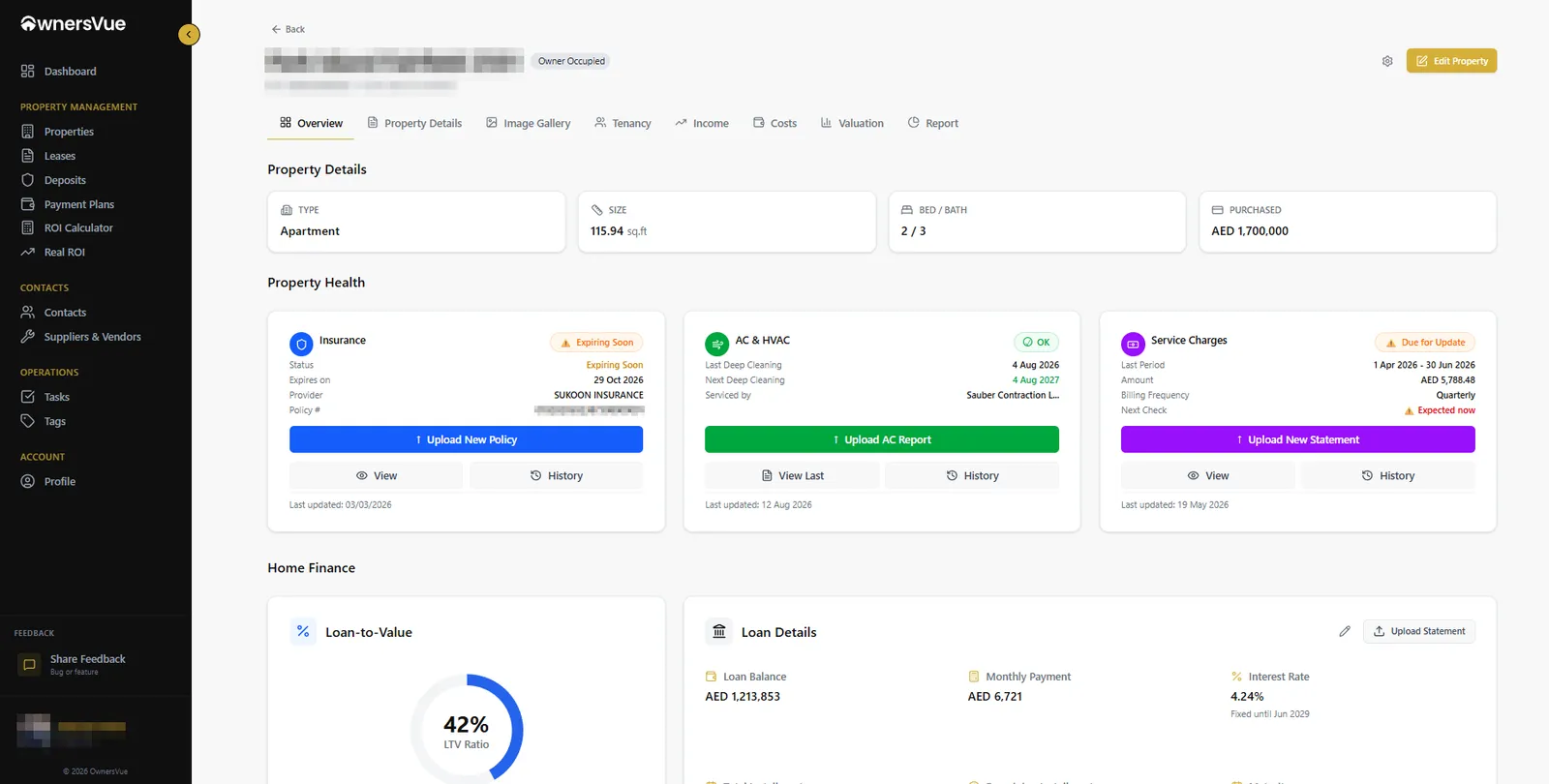
OwnersVue - Property Dashboard for Owners showing Expiry of important Contracts and Deadlines
Investor-grade performance on their own capital
An agency owner statement tells a landlord what came in and what went out.
For an investor, that is only part of the picture.
They may also want to understand metrics such as:
- Cap Rate
- Cash-on-Cash Return
- Net Yield
- Total income
- Total property costs
- Performance over time
For an individual owner, these numbers help answer the larger question behind owning the property in the first place:
Is this investment actually performing well?
Owner and property manager working on the same property
Owner-centric software doesn't necessarily mean the owner has to do everything themselves.
Many owners manage some aspects of a property directly while using brokers, contractors or property managers for others. Some may eventually hand the entire day-to-day operation to a property manager.
Agency platforms typically approach the owner as a client of the property management business.
An owner-centric system can approach the relationship from the other direction: the property remains part of the owner's portfolio, while a property manager can be given access to manage it on their behalf.
That allows both sides to work around the same underlying property record without changing who the asset ultimately belongs to.
Landlord software vs. agency software: the difference at a glance
| Area | Individual owner | Property management agency |
|---|---|---|
| Primary goal | Manage and understand owned assets | Operate properties on behalf of clients |
| Property ownership | Owns the properties being managed | Usually manages properties owned by others |
| Financial focus | Investment performance and property-level returns | Client accounting, collections and operational reporting |
| Reporting | Property and portfolio performance | Portfolio-wide operational and owner reporting |
| Documents | Central records for owned properties | Documents across multiple properties and clients |
| Deadlines | Renewals, insurance, maintenance and property obligations | Operational deadlines across a managed portfolio |
| Client management | Usually unnecessary | Core requirement |
| Team workflows | Often limited | Important as operations scale |
| Owner access | Owner is the primary user | Owner is typically a client of the management operation |
Neither model is inherently better.
They are designed around different jobs.
Do individual landlords need channel management software?
Only if they're actively running short-term or holiday-home rentals across multiple booking platforms.
A landlord with one or two long-term tenanted units has no listings to synchronise and no channel conflicts to prevent, so channel management may be a feature they pay for without using.
It becomes relevant when a self-managing owner starts listing the same holiday home through Airbnb, Booking.com or other channels.
At that point, keeping availability and reservations synchronised becomes a genuine operational requirement.
For long-term landlords, however, the priority is usually somewhere else.
The mismatch can cost more than the subscription
The cost of choosing the wrong software isn't necessarily the monthly subscription itself.
A solo owner can pay for agency-focused functionality such as complex accounting and operational workflows while still maintaining separate spreadsheets for investment returns, deadlines and property records because those are the questions they actually need answered.
The opposite problem also exists.
Tools built for landlords in other markets may not understand Dubai-specific structures such as Ejari, service charges verified through the Dubai Land Department's Mollak system, or DEWA premises numbers (Dubai Land Department).
For an overseas owner who can't rely on local knowledge to fill those gaps, that distinction matters.
What should a property owner actually look for?
If you're an owner comparing property management software, start with the problems you actually need the platform to solve.
Does it help you track important dates such as tenancy renewals, service charges, insurance and maintenance?
Does it show what the property is actually earning and calculate investment metrics such as Cap Rate, Cash-on-Cash Return and Net Yield?
Can you keep documents attached to the property rather than scattered across folders and inboxes?
Can important information be extracted from those documents rather than entered manually every time?
And if you decide to use a property manager, can they work on the same property while you retain visibility as the owner?
Those questions are very different from the ones a property management company asks when choosing software for a team running a large portfolio.
That's ultimately the distinction that matters most.
Agency software is designed primarily to help run a property management operation. Owner-centric software is designed primarily to help someone manage, understand and protect the assets they own.
The right choice depends less on whether you have two properties or twenty than on which of those jobs you're actually trying to do.
Sources
- Dubai Land Department – Register/Renew Tenancy Contract (Ejari)
- Dubai Land Department – Registration and Renewal of the Real Estate Management Contract
- Dubai Land Department – Service Charge Index
- Hotel Tech Report – Property Management Systems
- Property Finder – Rental Dispute in Dubai: Types, How to File, How to Solve and More